Interaction design / Creative development
A portfolio.
A little town.
A different way in.
Project Town turns browsing my work into a small adventure: choose a character, wander between neighborhoods, take a guided tour of a building, run an errand or two, and maybe catch the ferry to my house.
Work in progress · Playable prototype · Updated November 16, 2026

- Project
- Experimental portfolio view
- My focus
- Experience design, writing, and creative development
- Built with
- HTML, CSS, JavaScript, Canvas; placeholder tiles from Kenney’s Tiny Town (CC0)
- Stage
- Playable prototype; original art replacing placeholder tiles
Current build / November 16, 2026
Where it is now.
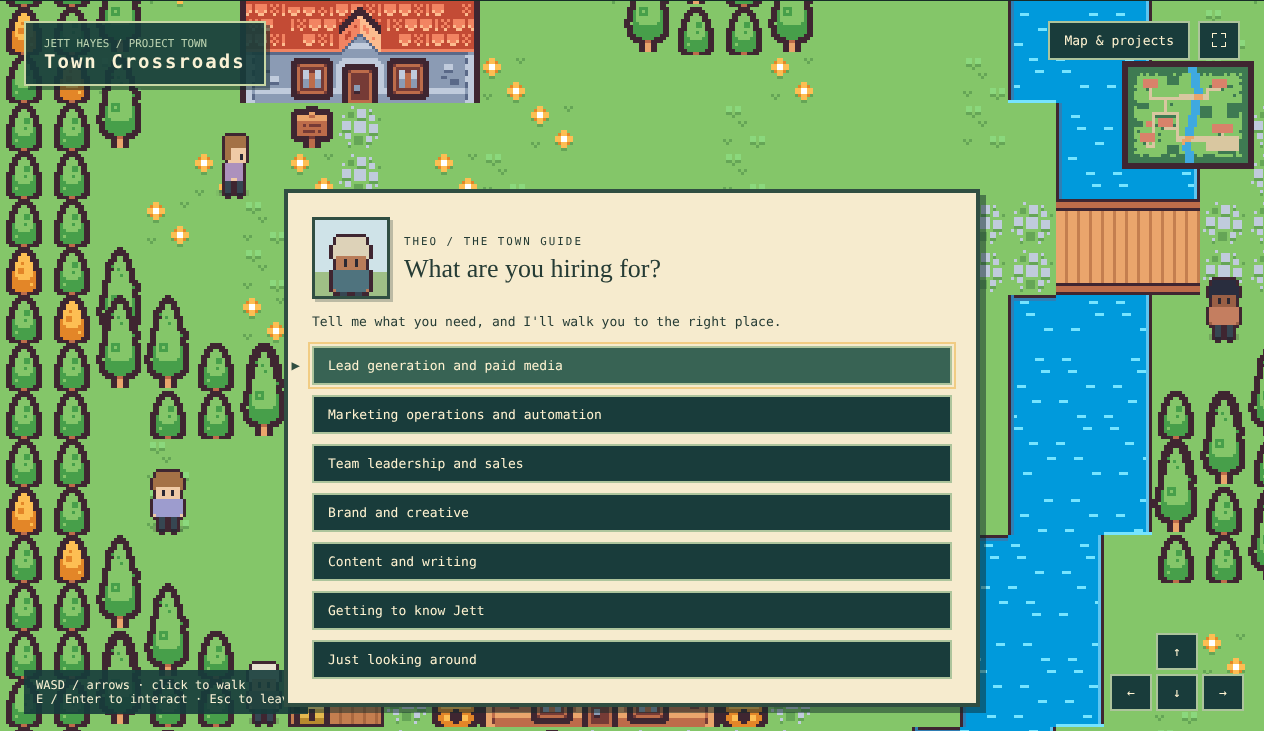
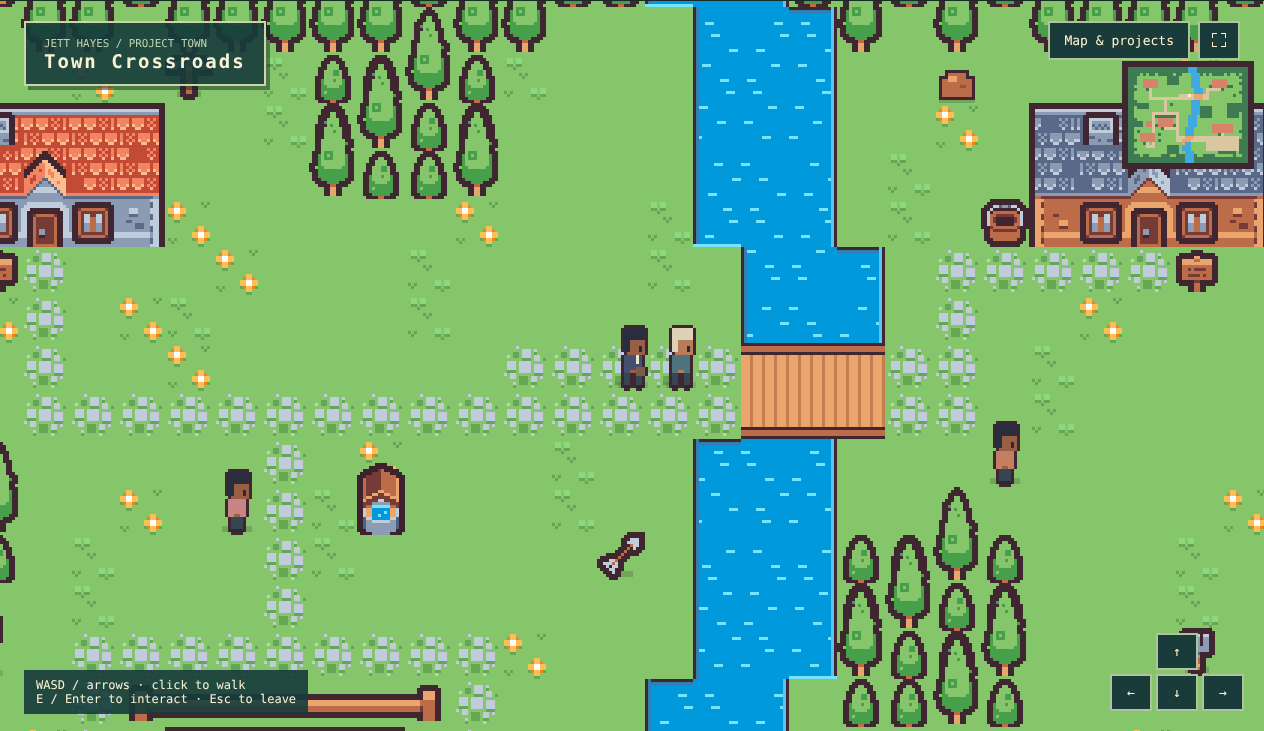
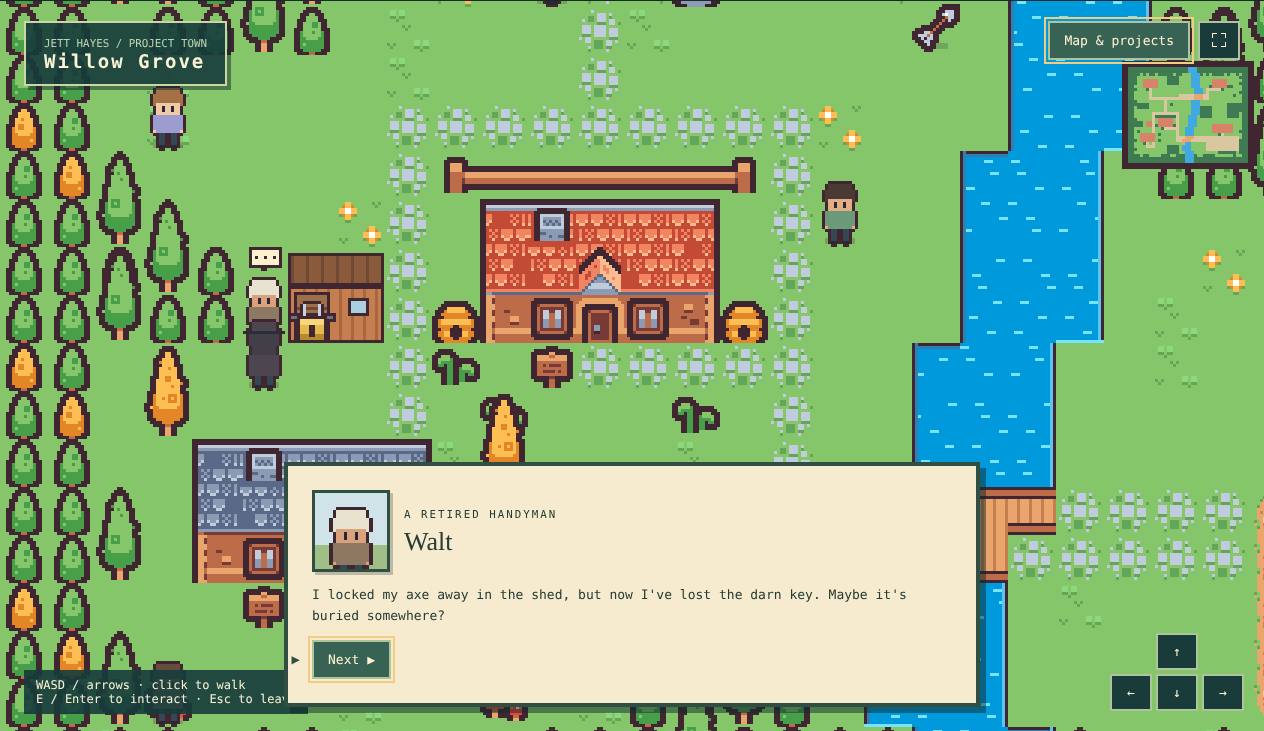
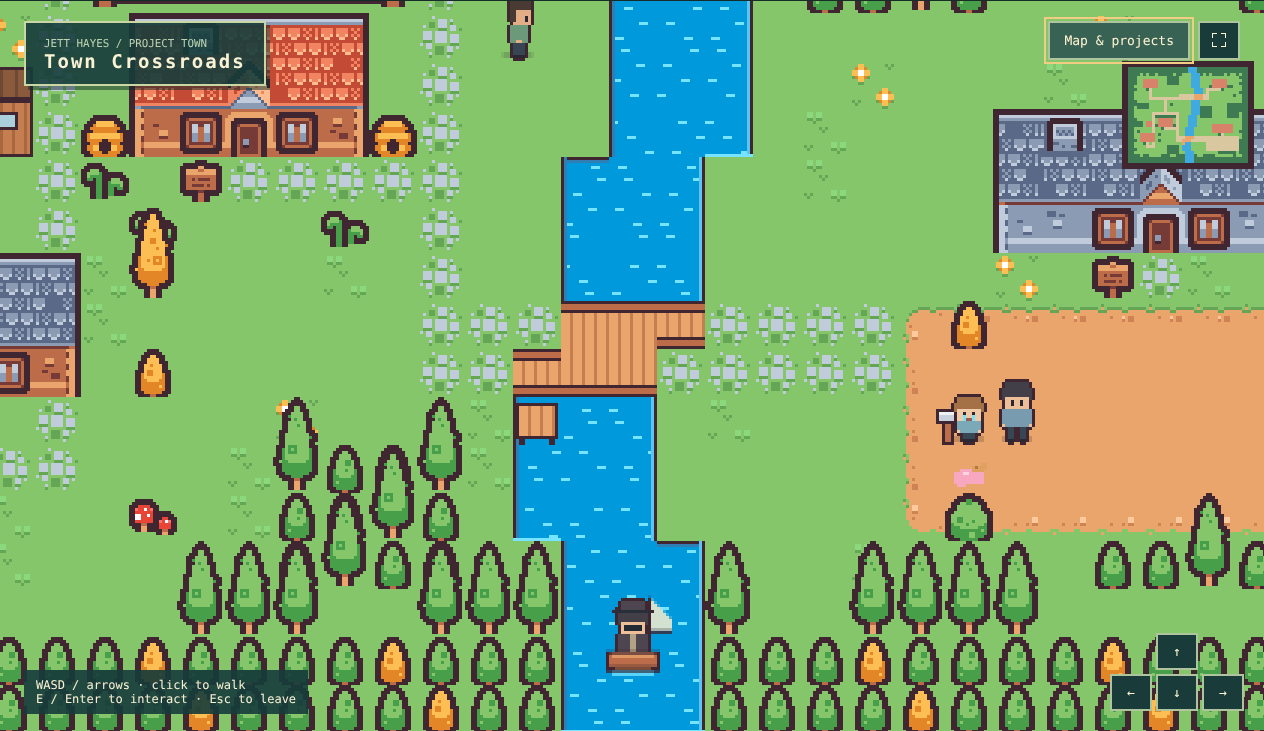
Eight screenshots from the current build, taken the same day as the baseline below. Select any image to open it at full size.


Baseline / November 16, 2026
Where it started.
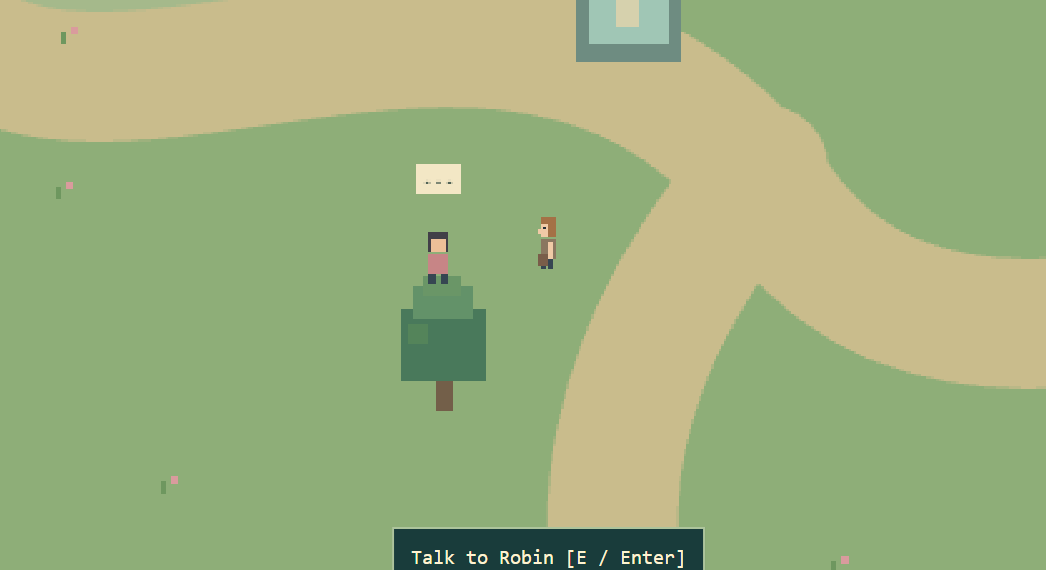
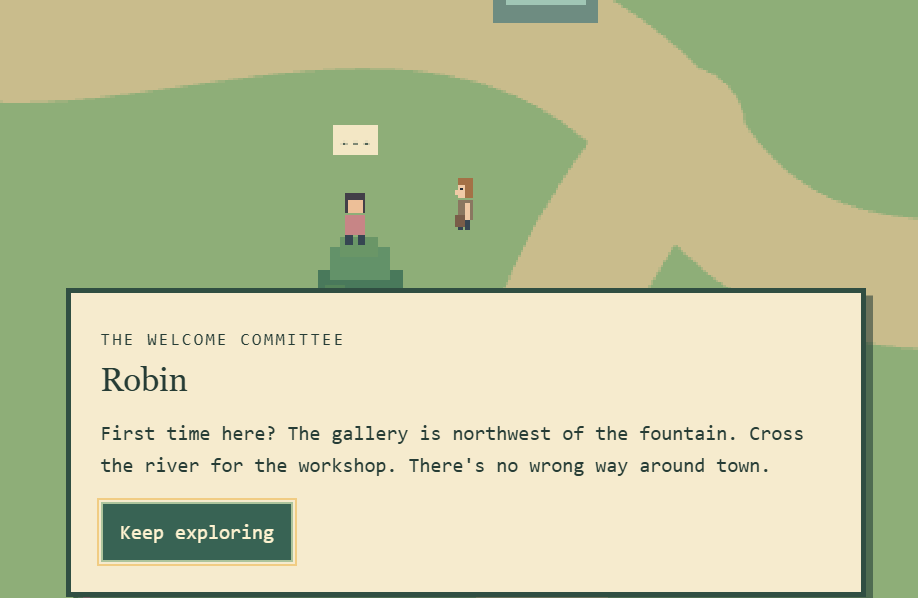
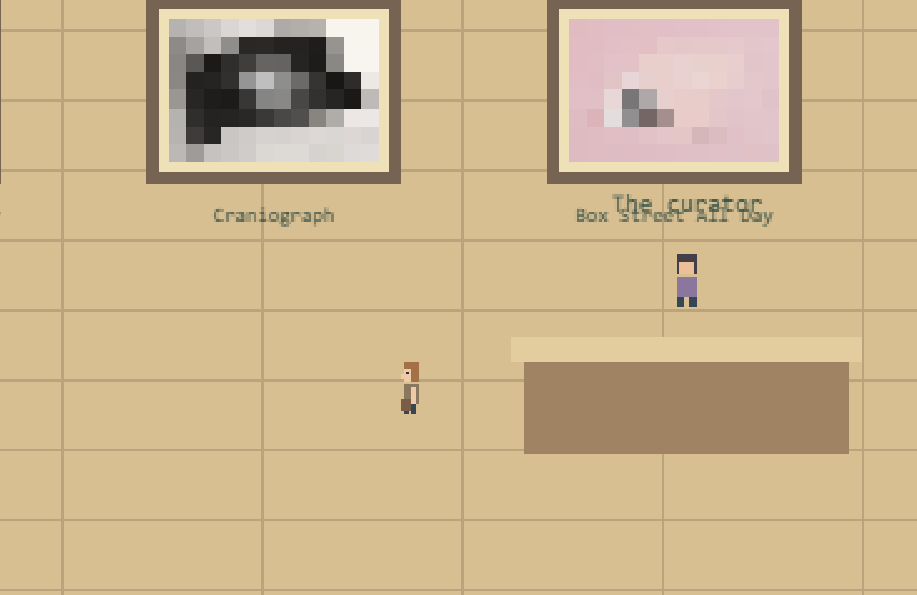
Four screenshots from the prototype before this pass: the arrival, outdoor exploration, a conversation, and the Gallery interior. They are kept unchanged for comparison. Select any image to open it at its original size.
01 / The brief
Make exploration feel personal.
My portfolio includes marketing systems, campaigns, visual design, photography, writing, and things I have built for the pleasure of making them. A conventional project grid makes the work easy to scan. I also wanted a way to explore the connections between it.
The Experimental view takes its cue from the small towns in old-school handheld role-playing games. A building gives a collection of projects a home. A conversation gives a visitor a reason to look closer.
The existing portfolio views remain available. Visitors can use the map to reach a project directly, or spend time wandering.
02 / Choose your character
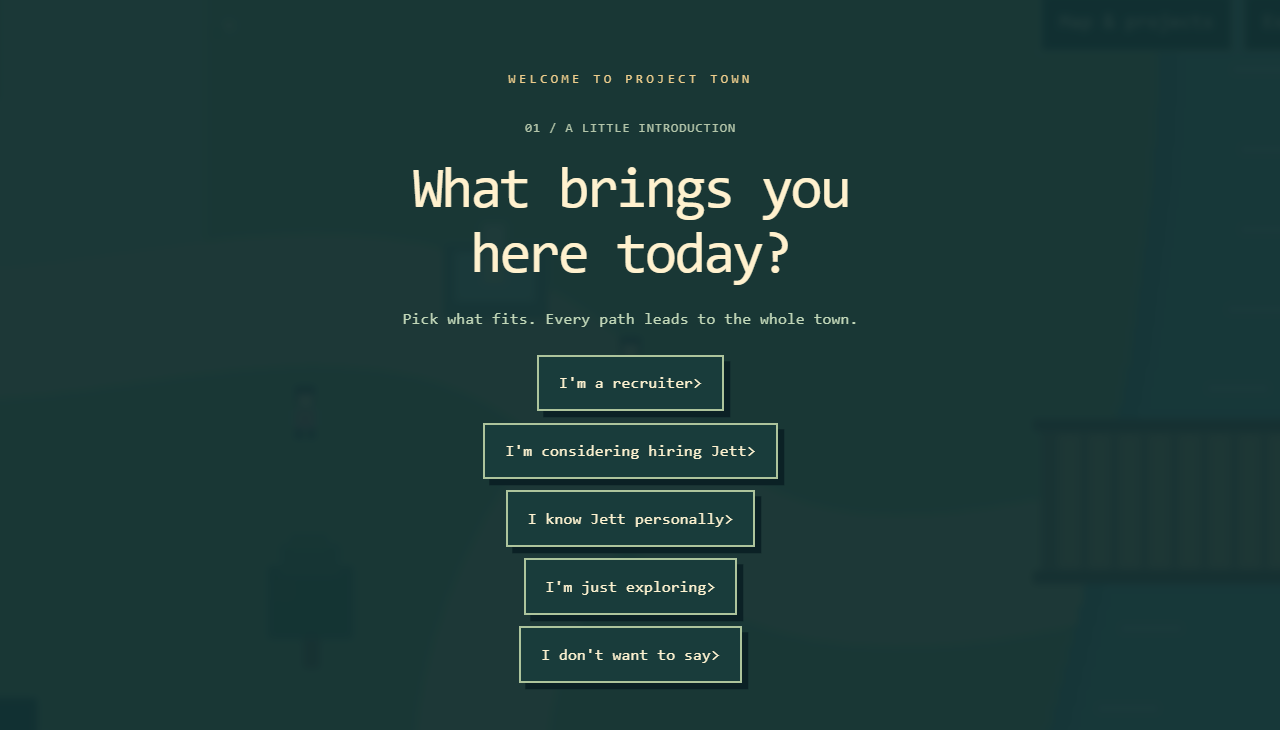
What brings you here today?
Press Start to wake up in town. Liz walks over and asks what brings you here; your reply shapes the character you explore as. Choose an appearance during the conversation, then set off. Every visitor can explore the entire town.
| Your introduction | Your character |
|---|---|
| I’m a recruiter | A polished jacket and lanyard |
| I’m considering hiring Jett | A professional in a suit, carrying a briefcase |
| I know Jett personally | A friendly local in PNW flannel and a beanie |
| I’m just exploring | A traveler with a backpack |
| I don’t want to say | An incognito guest with a hat and sunglasses |
The answer does more than pick an outfit. Recruiters and hiring managers meet Theo, the town guide, who asks what they are hiring for: lead generation and paid media, marketing operations and automation, team leadership and sales, brand and creative, content and writing, or getting to know me. Whatever they choose, he walks them to the right door. Anyone else can find Theo by the well and ask the same question.
Hold a direction to walk tile by tile, tap a direction to turn in place, or click anywhere to walk there. Every menu works with the arrow keys and Enter, as well as mouse and touch, and a ▶ cursor shows what is selected.
03 / A place for the work
Five buildings. Different reasons to step inside.
Each building has a shopkeeper who offers a guided tour of the collection, one piece at a time: what it is, and whether you would like to hear more. Projects open in a new tab, so the tour waits for you to come back. Signposts outside read themselves as you walk up.
- 01 / Gallery Quarter
The Gallery
Visual work only: photography, posters, branding, and an exhibition piece. Artwork starts pixelated and comes into focus as you approach. The curator gives the tour.
Seven pieces. - 02 / Workshop Clearing
The Workshop
Automation, integrations, and things built by hand, including this town and the portfolio site itself. The tinkerer gives the tour.
Eight projects. - 03 / Riverside Gardens
The Greenhouse
Search, paid campaigns, and organic marketing live in a place devoted to growth. The gardener gives the tour.
Four projects. - 04 / Civic Square
Town Hall
Leadership and bringing people together: call coaching and the community awards campaigns. The town planner gives the tour.
Two projects. The notice board lists what is showing. - 05 / Willow Grove
The Reading Room
A quiet corner for writing, with a librarian to talk to.
Two articles.
Five residents live in town, and every one has a job: Liz welcomes you, Theo guides you, Walt has a quest, Rosa sells ice cream, and Milo needs one. An earlier version had six more people wandering around making small talk. They were cut because they added noise without adding a reason to talk to them.
04 / Things to do
Small errands that lead somewhere.
A portfolio game is only worth the detour if it ends somewhere useful. Every side path in town finishes at a way to reach me.
Walt’s lost tools
Walt, a retired handyman, lent out his tools and never got them back. The pickaxe and pitchfork are lying around town. The hammer is tucked in a nook in Civic Square, and Milo, a kid who just dropped his ice cream, is standing in the way. Rosa sells cones for one coin, if you can find one; cheer Milo up and he wanders off. The axe is locked in Walt’s shed on the far side of the river, and the key is buried somewhere, so you will need a shovel first.
Bring all five back and Walt hands over my résumé, with an offer to get in touch.
The ferry to my house
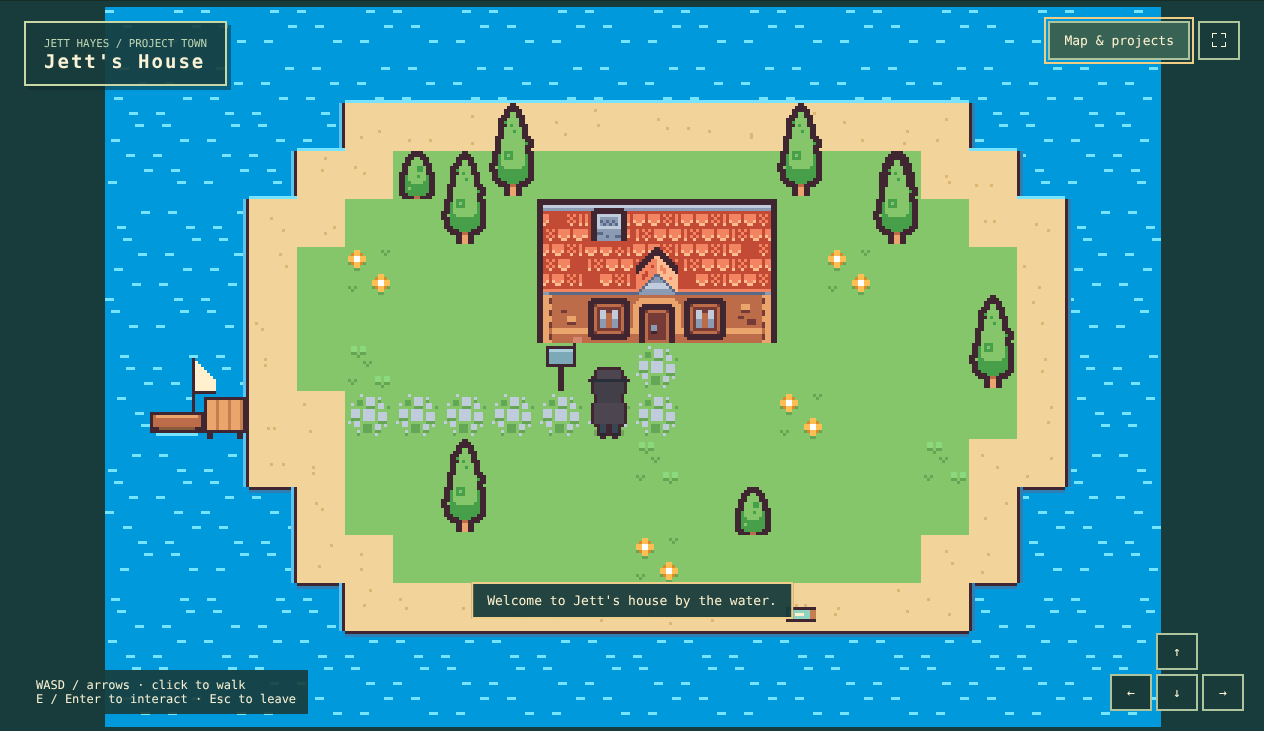
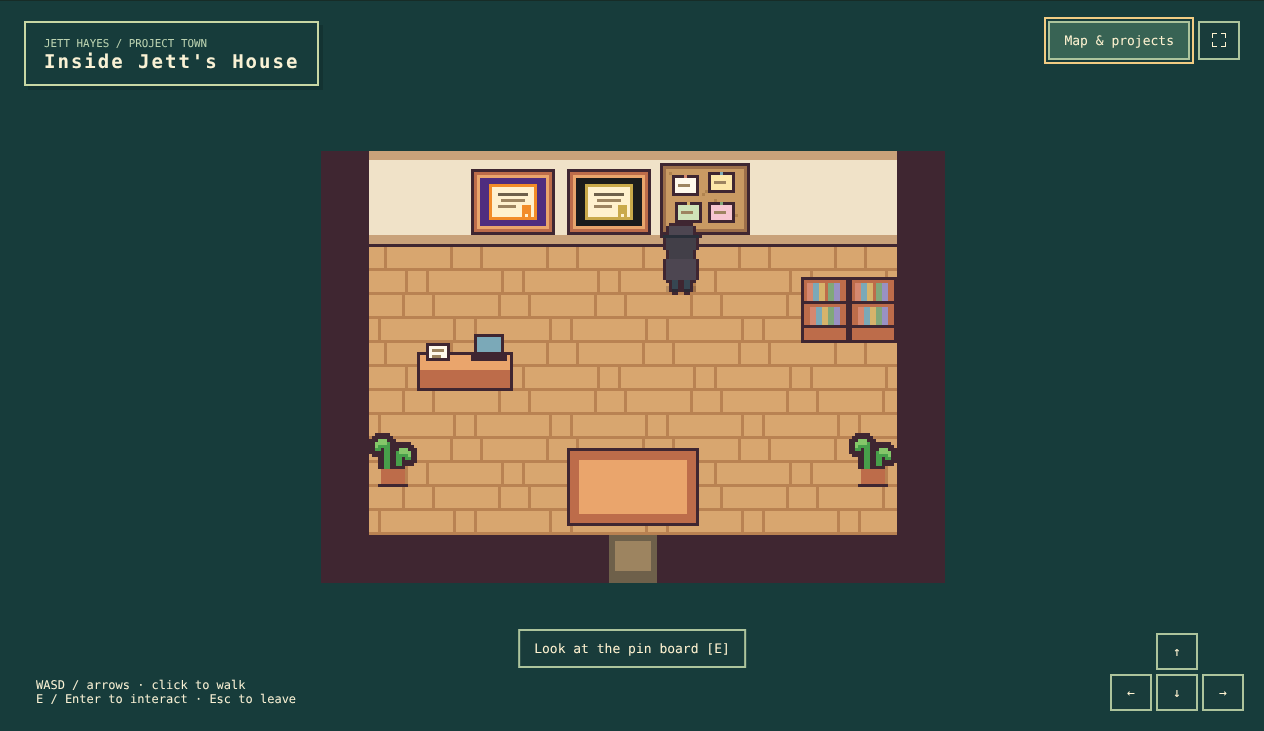
A sailboat below the south bridge carries you down the river to a small island with my house on it. Inside are my two diplomas, a bookshelf of favorite books, and a desk with my résumé and a note. A cork pin board zooms in to animated pixel polaroids of my early jobs: bartending, refereeing soccer games, mowing lawns, and teaching swim lessons.
Outside, the mailbox opens my contact page, and a message in a bottle asks whether you would like to share the town with someone.
There is also an archery range by the Workshop. Say yes and you step back to the firing line for a round of nine arrows: time each shot against a sweeping marker, and land three bullseyes in a row to win early.
05 / How it’s measured
A funnel, not just a game.
I build lead generation systems for a living, so the town reports on itself the same way. Every meaningful step sends an analytics event, tagged with the visitor’s answer to Liz’s question, so each audience can be read as its own funnel. The events work with GA4, Google Tag Manager, or Plausible, whichever is installed.
| Stage | What is recorded |
|---|---|
| Arrive | Viewed the town, pressed Start, answered Liz, finished or skipped the intro |
| Find the work | Theo’s question and answer, arriving with Theo, entering a building and how (walking, a door, or the map) |
| Engage | Tours started, each piece shown and its position, “tell me more,” skips, and leaving because it got boring |
| Convert | Project pages opened and from where, résumé and contact opened and from where, the town shared |
| Play | Items found, the quest finished, archery shots, the ferry, the house, the pin board, and the bookshelf |
The questions I want answered: Do recruiters take the guided path or skip it? Which pieces hold attention on a tour, and where do people decide they are bored? How many visits end at the résumé or contact page, and which route got them there?
06 / Designing through feedback
The first town was a directory.
This one is starting to feel lived in.
From one house per project to shared places
The first version used a building for each of the original 21 projects. Grouping them into five destinations creates a more understandable town and leaves room for the projects to grow. Each project now declares its own building, so none can end up empty.
From free movement to a tile grid
The larger rebuild drifted away from the handheld-RPG feel that inspired it: buildings were about nine characters wide, with empty grass between them. The town now runs on 16px tiles. Houses are five tiles wide, the player is one tile, and the screen scales in whole steps so the pixel art stays crisp on any screen.
From open fields to edges
Tree walls, fences, and water now enclose each neighborhood. The edges you can see are the edges you can walk into, while every building, resident route, and bridge stays connected.
From gliding to stepping
Characters now move one tile at a time, a little under a quarter second per step. Click-to-walk finds a path around obstacles, and you interact with whatever you are facing, the way those games always worked.
Less to toggle
Signs and notice boards show their text as you walk up, with nothing to open and close. Interiors fit on one screen, project images show whole, and the intro hides everything except a small Skip button.
07 / What’s next
Make it look like mine.
Then find out how it’s used.
The structure is in place. The next work is replacing borrowed art with my own and learning how real visitors move through the town.
Replace the placeholder tiles
Kenney’s Tiny Town tiles hold the layout together for now. Original tiles replace them one at a time on the same grid, starting with building walls. The water, bridges, interiors, characters, and portraits are already original.
Connect analytics
Install the analytics provider, confirm every event arrives, and review the funnel monthly by audience.
Watch people play
Sit with five people as they explore. Record what they understand, where they hesitate, and whether they find the résumé without help.
Move it into WordPress
The live site runs on WordPress. The town loads its art relative to its own script, so it can move without rewriting paths.
Keep direct browsing easy
The classic views and the map stay one click away. The town is an invitation, not a gate.